How do I keep track of all my assignments and due dates across my classes?
Published 16 September 2026, updated 18 September 2026
Collect your dates and grading weights in one place. Use them to decide what needs attention. Then turn each deadline into smaller pieces of work that land on your calendar before the due date.
That is the whole job. Here is how to do it tonight, with any planner you already use.

Step 1: Put every assignment in one place
Pick one place you will actually check. A paper planner, a notes app, a spreadsheet, or a desktop planner like Bento all work. The tool matters less than using a single list.
Make four columns:
- Course
- Assignment
- Due date
- Grading weight (percent of the final mark)
Then sweep through your stuff:
- Course outlines and syllabi
- Your learning management system
- Any assignment sheets or project briefs
For each graded thing you find, drop it into the list. If you do not know the exact weight yet, write a rough guess and mark it with a question mark so you can fix it later.
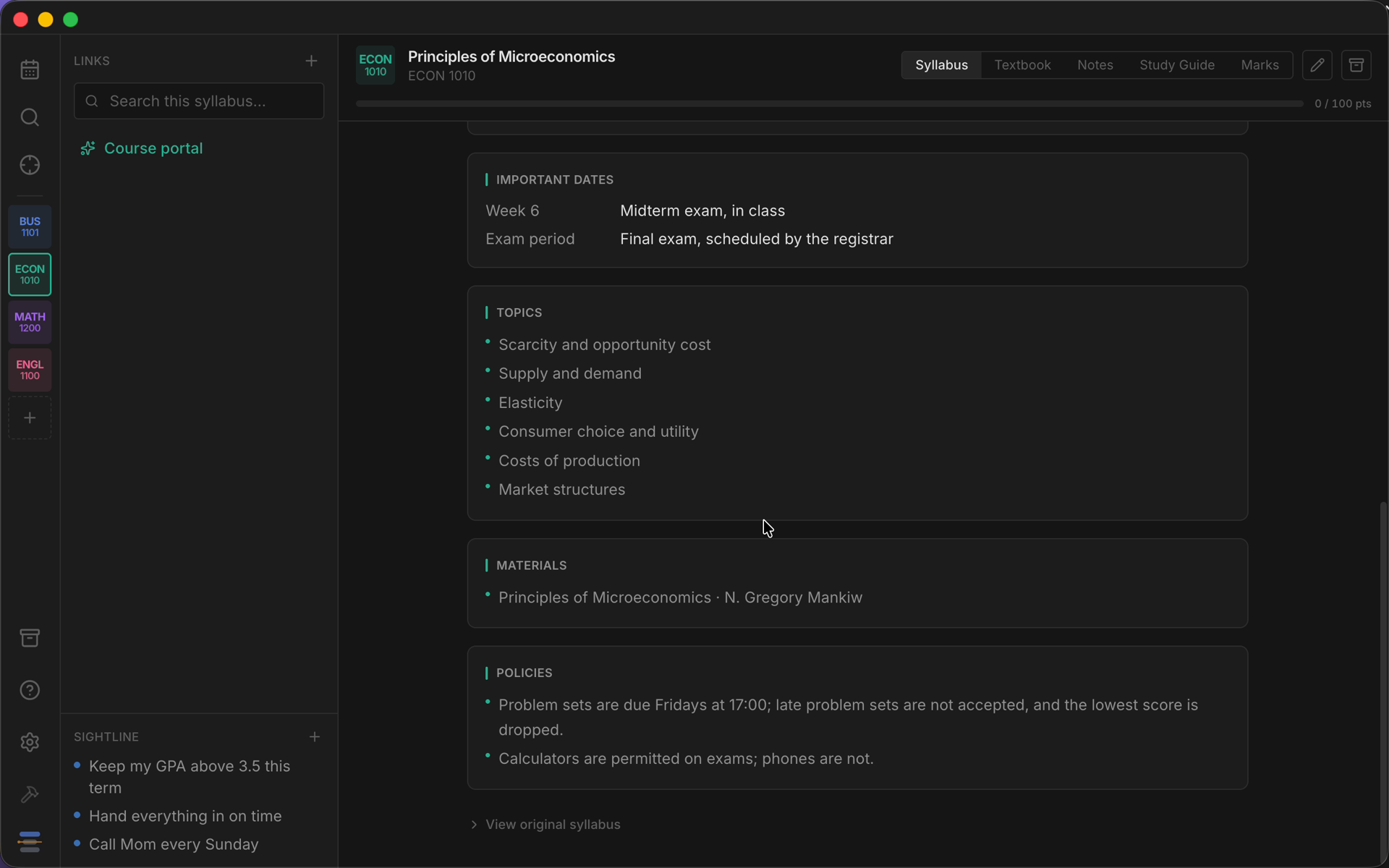
If you use Bento, you can drop a syllabus PDF onto a class and it fills in the dates and grading scheme for you, then shows every assignment on the calendar with its weight.
Step 2: Choose what to work on tonight
Imagine your list has three items:
- Chem 101, reading quiz, due tomorrow, 3%
- History 210, short essay, due in four days, 10%
- Psych 130, term paper, due in three weeks, 30%
Say you have two hours tonight.
Start with urgency. The quiz is due tomorrow, so it gets time first. Maybe it needs 30 minutes of reading and 15 minutes to answer questions. That is 45 minutes.
You have 75 minutes left. Now look at weight and size.
The history essay is worth less than the term paper, but it is due much sooner. You might give it 45 minutes tonight to outline and write a rough first paragraph.
You now have 30 minutes. Put that into the term paper. You will not finish much, but you can:
- Re-read the assignment description
- Pick a topic and write three bullet points
You have just made a choice that respects both urgency and weight. The quiz happened first because of the deadline. The essay came next because it is soon and nontrivial. The paper still got a small start because it carries a lot of weight.
If you do this kind of check-in at the start of each study block, your list turns into a set of concrete moves instead of background stress.
Step 3: Turn deadlines into a plan
A deadline is not a plan until you decide when you will do each piece of work.
For any assignment that needs more than one sitting, break it down:
- Understand the task
- Gather readings or sources
- Do the reading or research
- Draft
- Edit and proof
Give each step a rough time estimate, then place those steps on your calendar before the due date. Keep the last day as a buffer, not the main work day.
In Bento, you can see every class meeting, assignment and exam on the calendar at once. The AI reads the grading scheme and remaining assignments and helps you decide where to put your energy.
Most apps will show you when something is due. Bento is a desktop planner that also understands how the course is graded and builds study guides from your own notes, all stored on your computer instead of our servers.
If you want the organizing done for you, download Bento and drop a syllabus on a class. The planner is free; the organizing is done by AI, and that part you pay for.