How do you turn a pile of returned assignments into something useful for the next test?
Published 29 September 2026
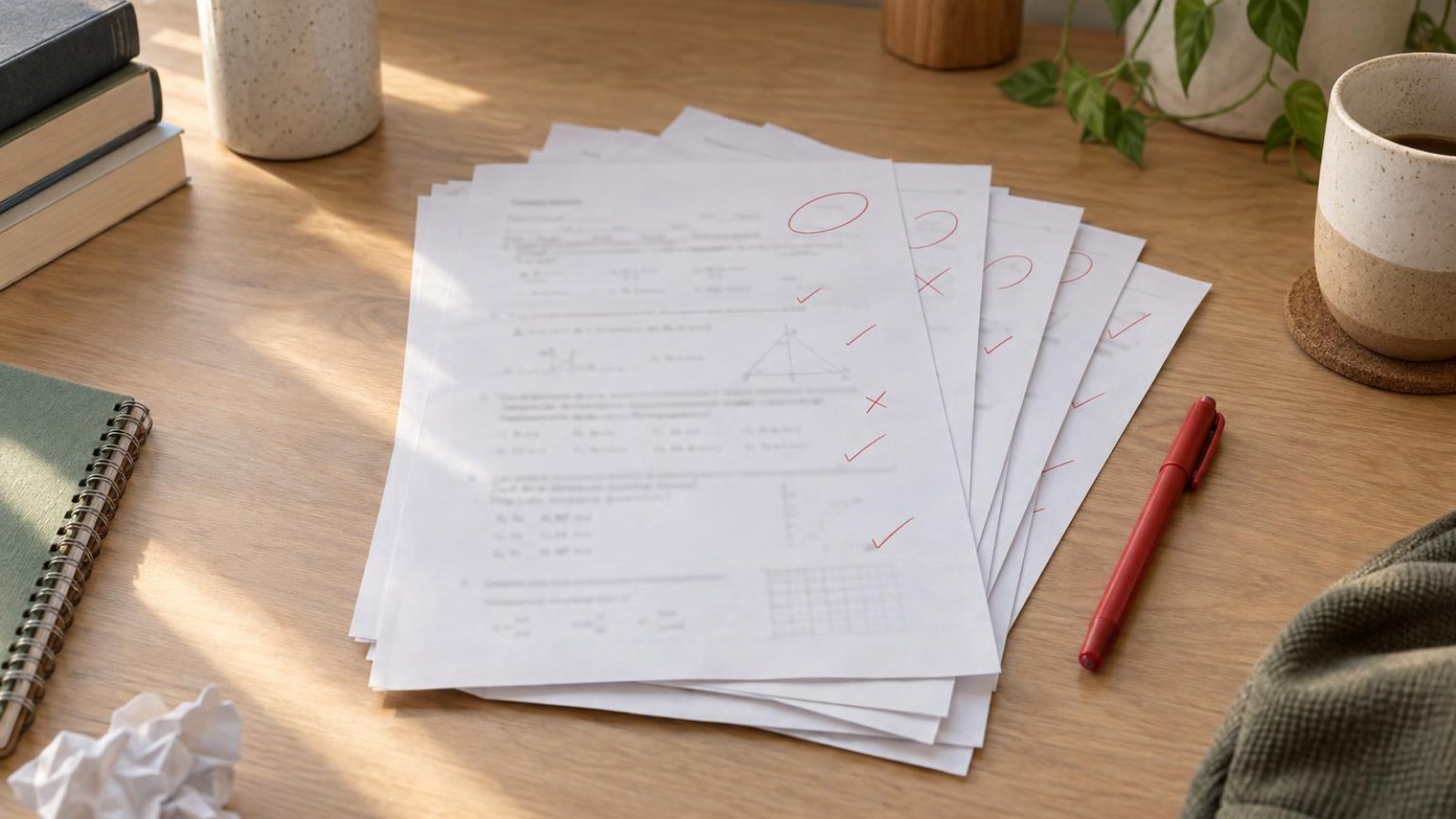
You have three quizzes back. Each one has a grade circled at the top, and you looked at that number, felt something about it, and put the paper in a folder. The midterm covering all of it is in two weeks. You haven't opened the folder since.
Here's the direct answer: read the feedback, not the grade. Sort what was wrong into two or three repeat categories. Study those categories first, before you touch anything else.
Say the three quizzes are each worth 5%, and the midterm ahead of you is worth 30%. That's a stack that's easy to dismiss as small. It isn't. Here's how to use it.
Read every comment before you look at the total again
Go back through each quiz and read what's actually written in the margins, not just the score at the top. On quiz one, the comment next to a lost point says "no page number in citation." On quiz two, a similar note: "missing citation format." On quiz three, no citation issue, but a comment reads "wrong formula used for part b." On quiz one again, buried lower down, the same formula mixup.
You already have this information. You paid for it with the mark you lost. The only step here is looking at it on purpose instead of once, quickly, right after it was handed back.
Sort the losses into two or three piles
Don't make a list of every single point lost. Make a short list of the kinds of mistakes. In this example, you land on two piles: citation format, and the wrong formula for a certain kind of problem. That's it. Three quizzes, a dozen small deductions, and it collapses into two things.
This is the part that's easy to skip, because it feels like extra work before the real studying starts. It is the real studying. A pile of graded paper is not a study plan. Two named categories are.
Study the categories, not the quizzes
Now you know what to review, and it isn't "everything from the first half of the course." It's citation format, specifically, and the one formula you keep swapping out for the wrong one. Pull up the actual rule for how the citation should be formatted. Pull up the formula and the condition that tells you when to use it versus the other one you keep grabbing instead.
Ten minutes on citation format. Ten minutes on the formula, with two or three practice problems that force you to pick the right one. That's twenty minutes that covers what actually cost you points three separate times, instead of a two-hour reread of the whole textbook chapter hoping something sticks.
Check the pile against what's coming
Before you move on, look at what the midterm actually covers. If citation format and that formula both show up again, you've just spent your time on the highest-value review available to you. If one of them doesn't apply to the midterm at all, you still know it for the final, and you didn't waste the twenty minutes; you just didn't need to spend more than that on it tonight.
This is the step that keeps the method from turning into a second project. You're not building a new tracking system. You're using the one your grader already handed you, on paper, three times.
Bento does the reading-across-quizzes part of this. Drop your returned quizzes in and it reads the marked-up feedback on each one, the same comments you'd otherwise reread by hand three separate times, and shows you where the marks went on each piece. It also shows where the remaining marks are, on the midterm ahead. Sorting that into "citation format" and "wrong formula" as the two categories worth reviewing first is still yours to decide. Bento is a desktop planner for university students. It runs on your own computer, Mac or Windows, and there's no account to make.
Try this tonight: Pull out your most recently returned assignment, whatever it is. Read every comment on it, not just the grade. Write down, in one line, the one thing that cost you the most points. That's category one. You'll find category two on the next one back.
Bento is free to download: download Bento.